Shakhi Singh
Content Creator
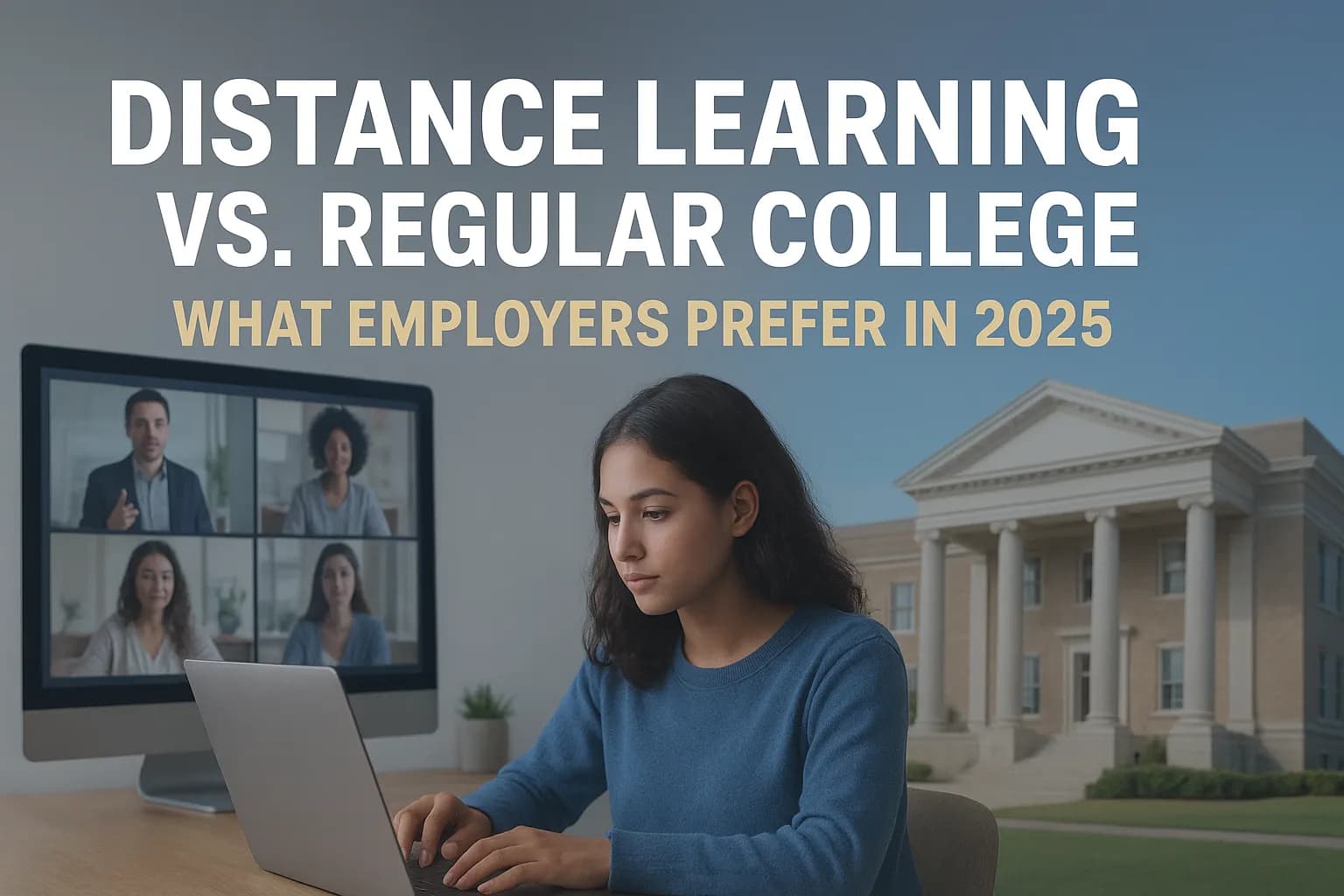
The short answer for 2025 is clear: Employers increasingly value the skills you possess and the quality of the institution more than the delivery format of your degree. A traditional degree from a top university remains highly respected, but an accredited online degree from a reputable school is now often viewed as its equal. A 2025 global education report notes that 83% of HR professionals see an accredited online degree as equal to a traditional one, and over 75% of employers hired online degree holders in the past year. The pandemic normalized digital work and learning, dissolving the old stigma. Ultimately, if your degree is from a recognized university and you bring in-demand skills like digital proficiency, self-motivation, and work ethic, your distance education recognition is strong and the online degree job value is high.
The world of work and education has transformed dramatically over the last few years. The sudden, forced global shift to remote operations and learning fundamentally changed how employers view remote skills and virtual collaboration. This change has been a massive, permanent boost for distance learning.
The online degree market is on a rapid growth trajectory, forecasted to reach an estimated $74 billion in 2025, according to education market insights. This demonstrates the sheer scale, trust, and growing demand for this flexible educational model. This is not a temporary trend; it is a structural change in higher education, making quality education more accessible and geographically flexible than ever before.
For decades, a small, stubborn stigma was sometimes attached to degrees earned outside the traditional physical campus setting. However, the events of the last few years have completely broken down this barrier.

This is the foundational question for anyone considering an alternative path. The answer is an unambiguous yes, a distance degree is valid for a job, provided you make a conscious choice to select an officially recognized and accredited program.
Hiring managers in 2025 focus on three main pillars when assessing your academic credentials, regardless of whether you studied on-campus or remotely:
It's important to distinguish between the two primary forms of remote education in 2025:
| Aspect | Online Learning (Modern Distance) | Traditional Distance Education (ODL) |
|---|---|---|
| Interaction | High. Live virtual classes, video conferencing, real-time group discussions. | Low. Primarily self-study using printed materials or recorded media; limited teacher-student interaction. |
| Pace | Structured, with virtual class schedules and fixed deadlines. | Highly flexible, often allowing students to study at their own pace with minimal deadlines. |
| Format | Wholly digital (lectures, assignments, exams, and support all online). | Primarily physical/print-based, with exams usually requiring travel to a test centre. |
| Employer Perception | Very high; often seen as equivalent to traditional learning due to interactive rigor. | High; well-accepted, but the non-interactive nature is sometimes noted. |
For maximum online degree job value, the interactive, modern Online Learning model is often seen as superior because its structured nature mimics a regular college schedule while embedding essential digital skills.
| Skill Developed Through Distance Learning | Why Employers Value It in 2025 |
|---|---|
| Time Management & Self-Motivation | Successfully managing independent study while juggling life/work is proof of the maturity required for remote roles. |
| Digital Proficiency | You are already comfortable with collaboration tools (Zoom, Slack), digital platforms, and virtual file sharing, the new standard for all teams. |
| Flexibility & Adaptability | The ability to quickly adapt to new learning technologies and environments showcases resilience, a top-tier soft skill in 2025. |
| Real-Time Application | For working professionals (e.g., an Online MBA student), you apply new concepts immediately in your job, making the learning intensely practical and job-ready. |
| Effective Written Communication | Virtual communication forces a clarity and conciseness in writing that is essential for remote teams that rely heavily on email and chat. |
The online degree job value is exceptionally strong in sectors driving the future economy, as these programs are often designed in collaboration with industry experts to ensure the curriculum is up-to-date:
| Feature | Distance Learning (Accredited Online) | Regular College (On-Campus) | Employer Preference (2025 View) |
|---|---|---|---|
| Job Validity | Fully Valid. Recognized by UGC-DEB/equivalents for both private and government jobs. | Fully Valid. The long-established gold standard. | Equal Value. Validity hinges entirely on accreditation and university reputation. |
| Cost | Significantly Lower (Up to 70% Less). Saves on tuition, housing, and relocation costs. | Highest Cost. Includes high tuition, mandatory fees, and high living/hostel expenses. | Not a factor in the hiring decision, but a huge benefit for the student’s financial future. |
| Networking | Moderate-High. Relies on virtual platforms, LinkedIn, scheduled hybrid meetups, and a global cohort. | Very High. Built-in, organic opportunities through campus events, clubs, and local alumni chapters. | Advantage On-Campus. Online students must be more proactive and intentional in their networking efforts. |
| Digital Skills | Excellent. Digital tools and virtual collaboration skills are embedded into the daily learning process. | Good. Digital literacy is required but less central than in an online program. | Highly valued. Online students demonstrate mastery of remote work from day one. |
| Work/Life Balance | Superior. Allows balancing a job, family, or other commitments without career interruption. | Difficult. Requires full-time commitment, often necessitating quitting a job or taking a break. | Favored. Indicates a candidate is mature, resilient, and capable of high-level multitasking. |
| Geographical Access | Global (GEO-Friendly). Study from any remote location to access top-tier education. | Localised. Requires living within commuting distance or relocating to the campus city. | Favored. Directly aligns with the increasing trend of remote and distributed global teams. |
For candidates in 2025, distance learning provides a crucial geographical advantage, making it highly and globally relevant. This is particularly transformative for regions outside major metropolitan centers.

In the competitive job market of 2025, the conversation has moved past "How did you study?" to "What can you do for our business?" Employers, particularly in large corporations and fast-growing tech sectors, are looking for the total package.
For technology, design, and increasingly, marketing and business roles, a well-built portfolio is your most valuable asset.
The commitment to continuous learning is critical. Distance learners, who often seek education while working, demonstrate this commitment naturally, signaling adaptability to change.
While technical knowledge is the entry ticket, the ability to collaborate and lead gets you the job and promotions.
Despite the overwhelming statistics in favor of the strong distance education recognition in 2025, you might occasionally encounter a traditional hiring manager with an outdated bias. Here's your simple, powerful strategy:
The debate between distance learning and regular college is functionally over in 2025. Employers have moved past the "where" and are fundamentally focused on the "what" (your skills) and "who" (your character). The demand for education that allows people to earn and learn simultaneously is skyrocketing, making an accredited distance degree a strategic and highly viable path for career growth, promotions, and career switches. Your online degree job value is determined by your strategic choice of a respected, accredited institution and your ability to showcase your hard-earned skills. The distance education recognition is stronger and more widespread than ever before.
Trust the data, choose a quality, accredited program, and lead with your skills.
Ready to Find Your Accredited Online Degree Program? Take the next step towards a future where your education fits your life, not the other way around. Explore Top-Rated Accredited Online Degrees and Career Paths Today!
© 2026 Nuvora Education Private Limited. All rights reserved.