
yogita
Content Creator
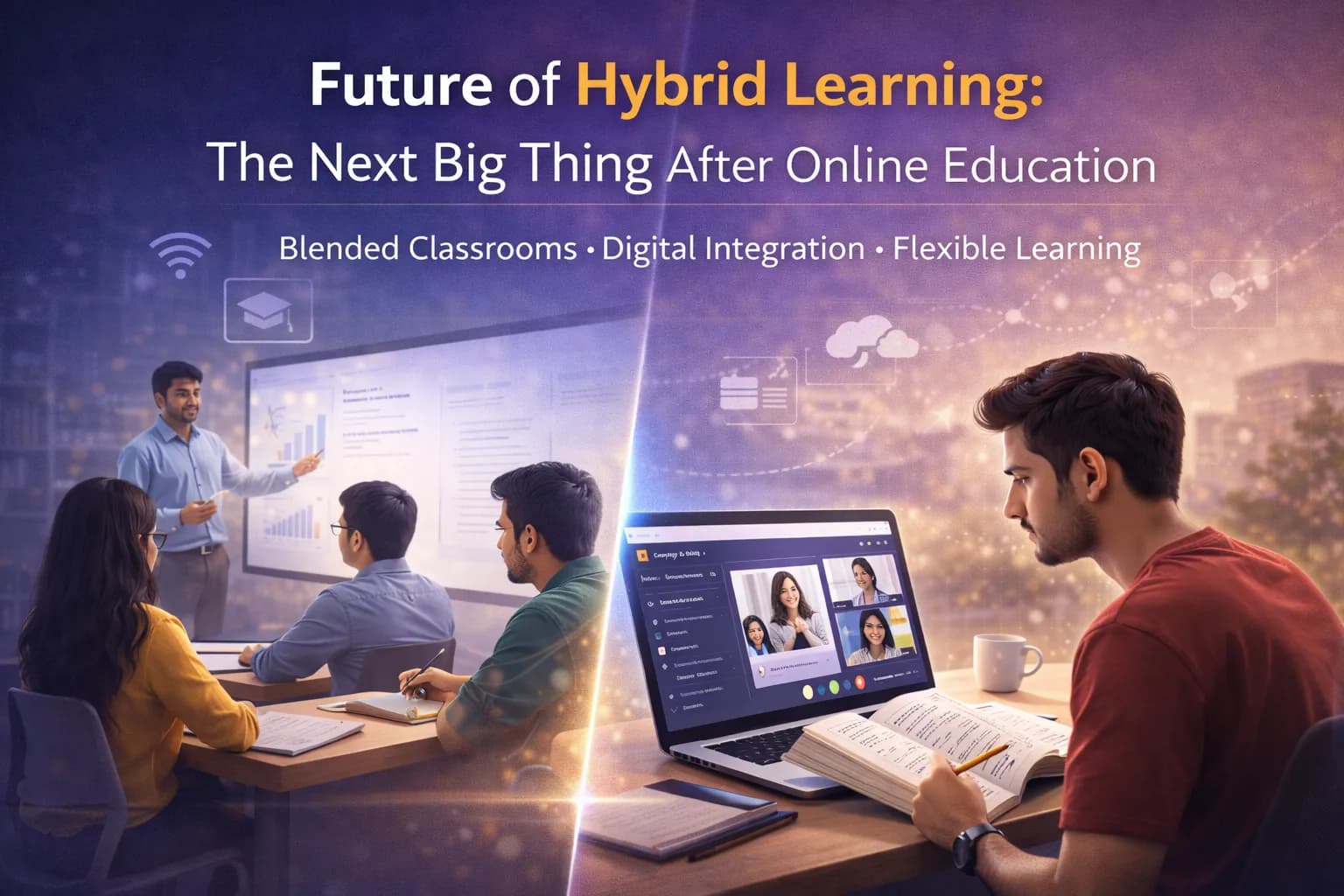
For those who were curious about what follows purely online education, it indicates that there is a shift toward hybrid learning, which merges quality online learning with face-to-face directed hours in the classroom. In our opinion, hybrid learning has the best of both worlds and is thus emerging as the next mode in educational advancement.
Hybrid academic experience (also called blended learning) refers to the instructional model for a student which includes face-to-face contact and online courses. Expert definitions clarify that it "combines traditional classroom teaching and includes online learning," with several flexible parts of the course being delivered digitally. Thus, hybrid learning uses technology to enable access by the students to lessons and discussions wherever, whenever, and also ways through physical classroom interactions.
With the rapid expansion of online education, particularly during COVID, authorities and learners are now more inclined to learning models that integrate online and in-person tuition. Findings from an HP India survey (Future of Learning Study 2022) indicated that 91% of students perceived online classes as complements to their face-to-face lectures; moreover, 68% of students and 85% of teachers want hybrid education models to continue. Another Indian survey validates the fact that even with students returning to physical attendance, hybrid education is becoming increasingly popular as students want to retain some elements of digital-enabled tools.
These numbers represented a demand for flexibility, improved engagement, and a more personalized approach to learning-hybrid learning is about filling that gap.

Lectures can be attended, recorded sessions viewed, and online resources used when students see fit. Scheduled times might be assigned for meeting in person. This is very useful for those students who, aside from studying, have work, family, and other commitments.
When done right, hybrid models create more of a community among learners. Studies indicate that students in blended courses feel they belong more, thus increasing motivation and retention.
Hybrid learning helps to instill face-to-face interaction with the use of technology (videos, adaptive software, or virtual labs). For example, in the hybrid realm, there is talk of innovative adaptive software and immersive tech.
Hybrid forms of learning are less severely disrupted when unforeseen incidents concerning sudden closures or natural disasters occur. Thus, learning continuity is maintained.
It seems to indicate that hybrid learning has evolved from being a novelty into an expectation.
| Feature | Traditional Classroom | Pure Online Education | Hybrid Learning |
|---|---|---|---|
| Physical attendance | Required | Optional / None | Required for some sessions; online for others |
| Flexibility in timing | Fixed schedule | High flexibility | Medium to high flexibility |
| Face-to-face interaction | High | Low | Moderate to high |
| Access to online resources | Varies | High | High |
| Personalisation & pace | Limited | High | High |
| Resilience to disruption | Lower | Higher | Higher |
Now, hybrid learning blends the advantages of online and offline modes: it brings qualitative improvement to students in sharing classroom time with peers while allowing for some flexibility with digital modality.
Hybrid learning has captured some attention and, at the same time, holds a few considerations for its effective application:
Hybrid learning shall avail itself to the well-heeled technologies like artificial intelligence, the analytics of data, and adaptive learning tools to provide a personalized experience to the individual student as per his pace and style in consuming the content.
Using VR and AR, simulations in practice can be realised in a hybrid format that permits the execution of real-world projects in otherwise partly online courses.
Learning through hybridization or modulating credentialing such micro-courses will matter for working adults, taking "learn-while-working" models instead of traditional full-time schooling.
With that, they'll also have more global hybrid classrooms built through collaborations across universities and countries. Examples include the Global Hybrid Classroom initiative that allows students from various regions to interactively engage with one another.
A model of hybridisation will enable institutions to gather better data, conduct real-time monitoring of learner engagement, put in place adaptive pedagogies, and have well-defined procedures for quality assurance and accreditation.
To summarise:
Whether you're a student, working professional or institution foresightedly looking to the future, hybrid learning should be a priority action item in your agenda.
Ready to start? Check out the latest admission sessions and apply before the deadline. Apply Today
© 2026 Nuvora Education Private Limited. All rights reserved.