
yogita
Content Creator
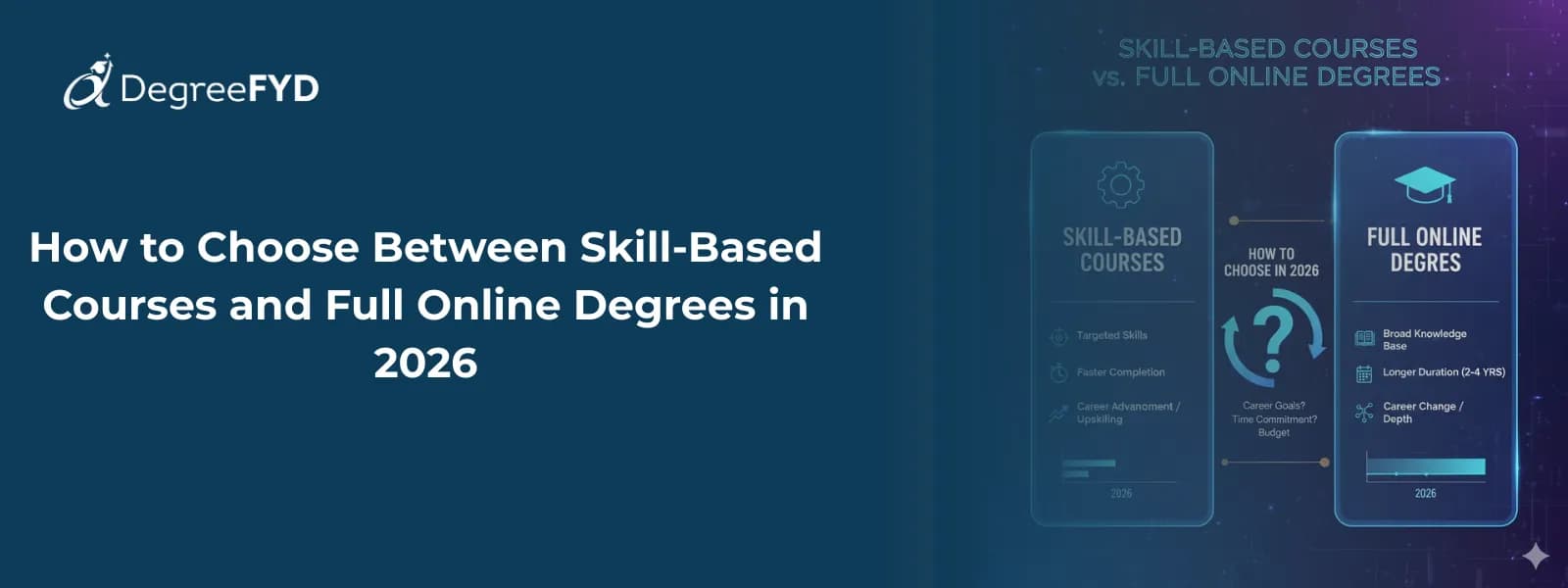
Choosing between skill-based courses and full online degrees can feel confusing. Many learners want fast job skills. Many also want strong educational qualifications. The question is important for career growth in 2026.
Employers focus more on both skills and education today. Job roles evolve fast in every industry. Skills help learners work better in modern jobs. Degrees help learners get formal recognition and career security.
This blog explains the degree vs skill debate and helps readers choose the best option for career growth.
India is becoming a skills-first economy.Companies are no longer hiring just based on degrees. Companies now prioritise practical abilities and hands-on knowledge.
However, degrees still matter for:
This means the new question is not degree or skills, but degree and skills at the right stage.
The job market in 2026 will be characterized by certain broad trends:
Skill-based programs are short-term courses designed to teach specific, job-ready capabilities. These programs focus more on doing than reading. They are structured around real work scenarios rather than theory.
| Category | Skills in Demand |
|---|---|
| Tech | AI tools, coding, cybersecurity, robotics |
| Business | Marketing automation, funnel building |
| Design | Graphic design, UI/UX, motion graphics |
| Data | Data science, ML, analytics, Power BI |
| Operations | HR automation tools, CRM mastery |
This makes them ideal for anyone who wants to enter the job market quickly.
Over time, lack of academic proof may limit promotions.
| Feature | Benefit | Limitation |
|---|---|---|
| Cost | Affordable | Some courses overpriced |
| Duration | Fast completion | Limited depth |
| Job Outcome | Quick entry | May not lead to senior roles |
| Recognition | Industry-recognized | Not always universal |
Online degrees offer structured education with formal recognition. They provide academic depth with flexibility. Universities use online classrooms, e-learning portals, mentor support, and live workshops.
| Category | Example |
|---|---|
| Management | MBA, BBA |
| Technology | BCA, MCA, B.Tech (Hybrid) |
| Humanities | BA Journalism, BA Psychology |
| Commerce | B.Com, M.Com, FinTech Degrees |
But long-term benefits outweigh the effort.
| Career Type | Degree Required? |
|---|---|
| Government roles | Yes |
| Engineering | Yes |
| Management roles | Strongly recommended |
| Creative freelance work | Optional |
| IT and technical roles | Optional but beneficial |
| Feature | Skill-Based Courses | Full Online Degree |
|---|---|---|
| Duration | Weeks to months | 2 to 3 years |
| Purpose | Immediate job readiness | Long-term academic and professional recognition |
| Cost | Affordable | Higher investment |
| Recognition | Industry-recognized | Universally recognized by institutions and employers |
| Job Relevance | High for practical roles | Required for structured roles, leadership, government |
| Best For | Quick employment, career pivot | Career stability, promotions, eligibility |
Hiring trends indicate a strong need for balancing both:
This further strengthens the degree vs skills debate. The future belongs to those who can prove validated knowledge and concrete skills.
The winning approach in 2026 is not choosing one. It is combining both:
This strategy builds a complete and future-proof career.
| Age/Stage | Best Path |
|---|---|
| 17–22 | Degree + 1 certification per year |
| Early career | Skill-based courses + specialization |
| Mid career | MBA/PG + leadership programs |
| Senior roles | Niche certificates + executive learning |
Yes. Degrees complement skills by offering:
DegreeFYD provides:
This makes the decision between skill based course vs degree easier and smarter.
Both options serve different career needs. Skill-based courses offer fast learning and job-ready knowledge. Online degrees offer long-term credibility and strong academic value. Choosing the right option depends on personal goals, learning style, and career plans. Some learners want quick job entry. Some want stable growth, promotions, or higher studies.
The best choice is the option that supports future plans, not just current trends. The right path should build skills, confidence, and long-term opportunities. Both skills and education matter in today’s career world. The strongest advantage comes when both work together.
Don’t wait to upgrade your skills. Begin learning immediately and move one step closer to better opportunities. Start Today
© 2026 Nuvora Education Private Limited. All rights reserved.