

Updated on 01 Mar 2026
By Jiya Tyagi, Content Manager
Candidates must check the below updates for CUET UG:
CUET UG 2026 application process has been reopened and is now open for candidates to fill and submit the form until 26 February 2026 (11:50 PM).
CUET UG 2026 examination is scheduled to be held in Computer-Based Test (CBT) mode from 11 May to 31 May 2026 (tentative) at centres across India and abroad.
CUET UG 2026 result is expected to be declared in late June or early July 2026 after the exam concludes.
CUET UG 2026 is a national-level entrance exam conducted by the National Testing Agency (NTA) for admission to India’s top central, state, private, and deemed universities in India. It is expected that the CUET 2026 application form will open in the first week of March 2026 at cuet.nta.nic.in, with the computer-based test (CBT) being held in May 2026. CUET UG 2026 will include a total of 23 subject domains, 13 languages, and the General Test, in keeping with NCERT academic standards. Candidates may choose up to five subjects according to university-specific subject mapping guidelines. Admission into universities will be determined by CUET scores, percentiles, and university-wise CUET cutoffs in 2026.
Below table provides overview of CUET exam, it includes exam structure, eligibility, mode, marking scheme and information.
| Particulars | Details |
| Exam Name | CUET |
| Full Form | Common University Entrance Test |
| Conducting Authority | National Testing Agency (NTA) |
| Exam Level | Undergraduate (UG) and Postgraduate (PG) |
| Exam Frequency | Once per year |
| Mode of Exam | Computer-Based Test (CBT) |
| Purpose of Exam | Centralised admission process for UG and PG courses in central, state, private and deemed universities |
| Eligibility Criteria | Candidates must have passed Class 12 or equivalent examination |
| Application Start Date | First week of March 2026 (Tentative) |
| Application Fee | General: INR 1000OBC-NCL/EWS: INR 900SC/ST/PwD/Transgender: INR 800International Centres: INR 4500 |
| Exam Duration & Slots | Slot I: 9:00 AM – 11:00 AMSlot II: 12:30 PM – 2:00 PMSlot III: 4:00 PM – 5:30 PM |
| Marking Scheme | +5 marks for correct answer–1 mark for incorrect answer |
| Medium of Examination | 13 languages including English, Hindi, Bengali, Assamese, Odia, Punjabi, Marathi, Gujarati, Malayalam, Tamil, Telugu, Kannada and Urdu |
| Official Websites | cuet.nta.nic.inexaminationservices.nic.innta.ac.in |
| Helpdesk Contact | Phone: 011-69227700 / 011-40759000Email: cuet-ug@nta.ac.in |
National Testing Agency (NTA) will release the official CUET 2026 schedule on its website. Candidates planning to appear for CUET UG 2026 should stay updated with the important dates. Check the below table for tentative CUET UG dates:
| Event | Date |
| Registration Re-opened | 23 February 2026 |
| Last Date to Apply Online | 26 February 2026 (up to 11:50 PM) |
| Last Date for Fee Payment | 26 February 2026 (up to 11:50 PM) |
| Exam Dates (CBT Mode) | 11 May – 31 May 2026 (tentative) |
| Admit Card Release | To be announced (expected before exam) |
| Result Declaration | Likely end of June 2026 (expected) |
Candidates appearing for CUET UG 2026 must fulfill the eligibility requirements set by the National Testing Agency. The eligibility conditions mainly include educational qualification, age limit, and nationality. Check the table below for CUET eligibility criteria:
| Eligibility Parameters | Details |
| Educational Qualification | Candidates must have passed Class 12 or equivalent examination from a recognised board in Science or a relevant stream. |
| Appearing Candidates | Students currently studying in Class 12 and awaiting their board examination results are also eligible to apply. |
| Age Limit | There is no upper or lower age limit for appearing in CUET 2026. However, candidates must meet the age criteria, if any, specified by the respective university or institution. |
| Nationality | Applicants must be Indian citizens to be eligible for the CUET examination. |
CUET UG 2026 application process is expected to begin in the first week of March 2026 on the official NTA website. Candidates looking for admission to undergraduate programmes through CUET must complete the online application within the given time. Check below the step-by-step process for the CUET UG 2026 application form:
Step 1: Visit the official CUET website and click on the CUET UG 2026 registration link
Step 2: Register by entering basic details such as name, contact number and email ID
Step 3: Receive login credentials after successful registration
Step 4: Log in and fill in personal, academic and Class 12 details
Step 5: Select preferred programme, CUET subjects and exam city
Step 6:Upload the required photograph, signature and documents in the prescribed format
Step 7: Review the filled application form carefully
Step 8: Pay the CUET UG 2026 application fee online using debit card, credit card, net banking, UPI or Paytm
| Category | Up to 3 Subjects | Fee for Each Additional Subject |
| General (UR) | INR 1000 | INR 400 |
| OBC-NCL / EWS | INR 900 | INR 375 |
| SC / ST / PwBD / Third Gender | INR 800 | INR 350 |
| Exam Centres Outside India | INR 4500 | INR 1800 |
Step 9: Submit the form and download the confirmation page for future reference
Candidate’s name
Father’s, Mother’s or Guardian’s name
Class 10 and Class 12 academic details
Date of birth
Gender and category
Uploaded photograph
Signature
Examination city preference (as per present or permanent address)
Note: Candidates are advised to carefully review all the details during the correction period,as no further changes will be permitted once the window closes.
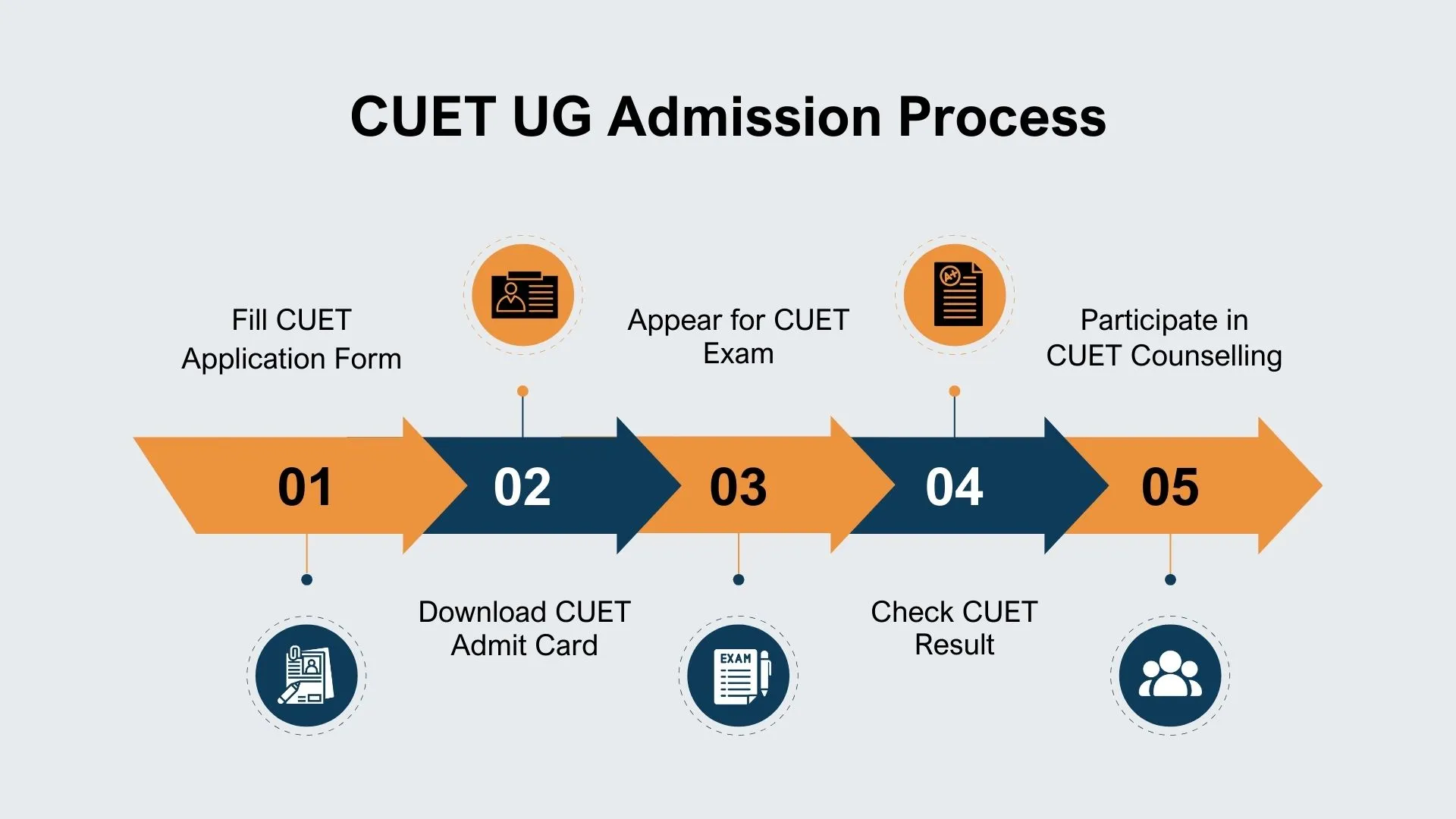
CUET UG 2026 admission process is a step-by-step procedure through which candidates get undergraduate admission to participating central, state, private and deemed universities. CUET UG is conducted by the National Testing Agency (NTA). The process begins with an online application and concludes with counselling and seat allotment by respective universities. Check the step-by-step CUET UG 2026 admission process:
Fill CUET Application Form
To prepare for CUET UG 2026, candidates can fill out the online application form, which includes filling in their name, address, date of birth, educational background, and any other necessary details, along with payment.
Download CUET Admit Card
Once candidates have successfully registered for CUET 2026, they may download their CUET card. Candidates must obtain their CUET cards from the official website to be eligible to take the actual exam.
Appear for CUET ExamIt is important for candidates to participate in the CUET UG 2026 exam using the computer-based option on the day of the scheduled exam and to arrive on time to the assigned testing site.
Check CUET Result
Throughout the qualification process for CUET, NTA publishes CUET scores with respective percentiles. The official portal provides candidates with access to their test scores.
Participate in CUET Counselling
Those candidates who qualify for CUET screening must participate in counselling and university admission processes. The allocation of seats is determined by CUET score results, cut-off scores, and select candidates’ interests.
Candidates can refer to the table below to understand the year-wise CUET registration and participation trends, which reflect the growing number of aspirants appearing for CUET exam.
| CUET Exam Year | Number of Applicants Registered | Number of Candidates Appeared |
| 2025 | 13,54,699 | 10,71,735 |
| 2024 | 13,47,820 | 11,13,610 |
| 2023 | 14,00,000 (Approx.) | 11,16,000 (Approx.) |
| 2022 | 14,90,293 | 9,68,201 |
CUET UG 2026 syllabus is based on the NCERT curriculum of Class 12, which includes subjects across various streams, including Commerce, Arts, and Science. To prepare properly for CUET, candidates are required to know and understand the CUET syllabus. The CUET syllabus is divided into 3 sections i.e., Language, Domain Subjects, and General Test. A section-wise overview of the CUET UG 2026 syllabus is given below:
| CUET Sections | Subjects / Question Types |
| Section I – Language | English, Hindi, Assamese, Bengali, Gujarati, Kannada, Malayalam, Marathi, Odia, Punjabi, Tamil, Telugu and Urdu. Questions include Reading Comprehension based on factual, literary and narrative passages, along with literary aptitude and vocabulary. |
| Section II – Domain Subjects | Accountancy, Biology, Business Studies, Chemistry, Computer Science, Economics/Business Economics, Geography, History, Home Science, Knowledge Traditions and Practices in India, Environmental Studies, Mathematics/Applied Mathematics, Physical Education, Physics, Political Science, Psychology, Sociology, Agriculture, Mass Media/Communication, Anthropology, Fine Arts, Performing Arts and Sanskrit. The syllabus is strictly based on the Class 12 Board examination syllabus. |
| Section III – General Test | General Knowledge, Current Affairs, General Mental Ability, Numerical Ability, Quantitative Reasoning (basic arithmetic, algebra, geometry, mensuration and statistics up to Class 8 level), and Logical & Analytical Reasoning. |
CUET UG 2026 exam pattern consists of three distinct sections, which include Language, Domain Subjects, and the General Test. The CUET exam covers 13 language options, 23 domain subjects, and one General Aptitude Test. As per the provided pattern, each subject paper will have a duration of 60 minutes. The detailed CUET UG 2026 exam structure is outlined below:
| Section | Number of Questions | Exam Duration |
| Section I – Language | 50 questions | 60 minutes per subject |
| Section II – Domain Subject | 50 questions | 60 minutes per subject |
| Section III – General Aptitude Test | 50 questions | 60 minutes |
CUET 2026 Marking Scheme
Candidates' scores for the CUET UG 2026 will be determined by how many subjects they chose to take. The National Testing Agency (NTA) has developed a marking system that will allow for accurate scoring of the CUET. Below is the detailed marking scheme for CUET 2026.
Correct Answer: Each correct response is awarded +5 marks
Incorrect Answer:1 mark is deducted (–1) for every wrong answer
Unattempted / Marked for Review:No marks (0) are awarded
Multiple Correct Options: If more than one option is correct, candidates selecting any correct option receive +5 marks
All Options Correct: If all options are correct, +5 marks are awarded to all candidates who attempted the question
Dropped or Incorrect Question: If a question is found to be incorrect or dropped, +5 marks are awarded to all candidates who attempted it
Candidates should develop a focused plan of attack before attempting to answer questions to increase their potential score on the CUET UG 2026.
CUET UG 2026 exam will take place at allocated exam centers throughout India and in some selected countries abroad. The exam will be available in 300 different cities, giving candidates many opportunities to test in areas near them. On their admit cards, candidates will find the precise location of their CUET exam. Before that, the NTA will provide candidates with a City Intimation Slip, which will inform candidates of the location of the exam's city and state. When applying to take the CUET exam, candidates must choose four preferred exam city centers. The NTA will attempt to place candidates in one of their preferred city centers, if the location is available.
CUET UG question paper consists of a total of 100 multiple-choice questions. The CUET is conducted using a computer, and therefore, candidates do not receive their question papers on the day of their examination. After the completion of the examination, the NTA will make both the question papers and the answer keys available through their website for candidates. Additionally, candidates have the ability to download their response sheets. Practicing previous CUET UG question papers in an exam-like, timed situation will greatly assist candidates in understanding the format of the examination and support improved preparation.
CUET exam is an extremely difficult competitive test that has a national scope. To prepare for the CUET, candidates will need to have a proper preparation strategy and a continuous work ethic. To help candidates in their preparation for the CUET, refer to these tips:
Understand the Exam Pattern:The first step in preparation is to review the format and question type/style of the CUET exam.
Select the Right Study Material: Use books of superior quality and text/resources that fully help candidates to prepare.
Strengths & Weaknesses Analysis: Find out where candidates' greatest strengths and weaknesses lie, and then focus on improving those areas where they need to improve.
Practice Regularly: Complete the entire class syllabus and take as many mock tests as possible. Getting experience by answering all of the questions on past years' exams allows candidates to observe the significance of various topics and types of questions in this exam.
Be Confident:Having confidence in yourself and a positive approach will be a significant factor in achieving success at the CUET.
Mock tests are important in preparing for CUET 2026. As per NTA, mock tests for CUET 2026 will be available online and enable candidates to become accustomed to a variety of components such as the virtual keyboard, on-screen calculator, movement between questions, and movement between sections. In order to prepare well, candidates should also complete mock tests provided by coaching institutes or subject experts since these mock tests contain questions pertaining to CUET exam sections. In addition, candidates need to review their mock test performance and then utilize that information to improve their areas of weakness to achieve the highest score possible in the CUET Exam.
CUET UG admit card will be released by National Testing Agency. Before issuing this ticket, NTA will send candidates an advance intimation slip, which includes details about their exam city, date, time slot, and papers. Candidates must bring their admit card to the examination center, as it is a requirement of participating in the exam.
Once the 2026 CUET admit card is available, candidates can log into their account using registration credentials to download it. A direct link for downloading the hall ticket will also be available on this page after the official release. To access your 2026 CUET admit card, follow these instructions:
Go to cuet.nta.nic.in (CUET's official site).
Select Log In/Sign In.
Provide your application number & password.
Select CUET 2026 Admit Card Download.
Save or print your CUET 2026 Admission Card. Make sure to keep a number of copies as a backup.
CUET UG 2026 city intimation slip will also be released by NTA for registered candidates. This slip provides information about the city and state of the exam centre and helps candidates plan their travel in advance. It is not the admit card but serves as a preparatory document for exam day arrangements. Check the below steps to download CUET 2026 City Intimation Slip:
Step 1: Visit the official CUET UG website, cuet.nta.nic.in.
Step 2: Enter your login credentials, i.e., application number, password, and captcha.
Step 3: Click on the “CUET UG City Intimation Slip” tab.
Step 4: The city intimation slip will be displayed on the screen.
Step 5: Download and take a printout for future reference.
NTA will publish a provisional CUET 2026 answer key for every candidate who takes the exam. The provisional answer key will include the correct answers to all of the questions and also the responses that candidates submitted. Using the provisional answer key and their CUET response sheet, candidates can calculate their scores before the official result is released.
Candidates may also challenge the provisional CUET UG 2026 answer key by paying a fee of INR 200 for each question they wish to challenge. All challenges submitted to the NTA will be reviewed by a committee of subject matter experts. If the challenge is accepted, the provisional answer key will be modified accordingly. The final CUET 2026 results will be based on this revised final answer key.
CUET UG 2026 result will be announced on the official website cuet.nta.nic.in of CUET. To view and access the CUET UG 2026 scorecard, candidates must provide their login details (username and password). The scorecard includes important details such as candidate information, section-wise and overall scores, percentiles, and cutoffs.
Central University Entrance Test (CUET) is a standardised examination that is held on multiple days, in multiple sessions/shifts, and across multiple subject areas. Therefore, in order to maintain fairness as much as possible, the exam is subject to a process of normalisation. Since it is possible that an individual taking a set of questions that is relatively difficult may receive a lower score than an individual taking a set of questions that is relatively easy, comparing raw scores between shifts is not an accurate comparison.
To accomplish this, the National Testing Agency (NTA) uses the equi-percentile method to normalise the raw scores of each candidate who has taken the test within each subject area. Raw scores of subjects that were held on only one day, in one shift, are not subject to a normalisation process.
CUET UG 2026 scores are accepted by a wide range of universities across India, including central, state, deemed, private, and government institutions. Candidates must check the eligibility criteria and course requirements of each university before applying for counseling.
| Central Universities | Central Universities | Central Universities |
| Central Tribal University of Andhra Pradesh | Central University of Andhra Pradesh | National Sanskrit University (Previously Rashtriya Sanskrit Vidyapeeth) |
| Rajiv Gandhi University | Assam University | Tezpur University |
| Central University of South Bihar | Mahatma Gandhi Central University | Guru Ghasidas Vishwavidyalaya |
| Central Sanskrit University | Jamia Millia Islamia | Jawaharlal Nehru University |
| Shri Lal Bahadur Shastri National Sanskrit University | South Asian University | University of Delhi |
| Central University of Gujarat | Central University of Haryana | Central University of Himachal Pradesh |
| Central University of Jammu | Central University of Jharkhand | Central University of Karnataka |
| Central University of Kerala | Dr. Harisingh Gour Vishwavidyalaya | Indira Gandhi National Tribal University, Amarkantak |
| Mahatma Gandhi Antarrashtriya Hindi Vishwavidyalaya | Manipur University | North-Eastern Hill University |
| Mizoram University | Central University of Odisha | Central University of Punjab |
| Central University of Rajasthan | Sikkim University | Central University of Kashmir |
| Central University of Tamil Nadu | Maulana Azad National Urdu University | Sammakka Sarakka Central Tribal University |
| The English and Foreign Languages University | University of Hyderabad | Tripura University |
| Aligarh Muslim University | Babasaheb Bhimrao Ambedkar University | Banaras Hindu University |
| University of Allahabad | Hemvati Nandan Bahuguna Garhwal University | Visva-Bharati University |
| Pondicherry University | — | — |
| State Universities | State Universities | State Universities |
| Baba Ghulam Shah Badshah University | Madan Mohan Malaviya University of Technology | Govt. Degree College (Autonomous), Baramulla |
| Barkatullah University | Madhabdev University, Narayanpur, Lakhimpur | Guru Gobind Singh Indraprastha University |
| Bhattadev University | Rani Durgavati University, Jabalpur | Harcourt Butler Technical University, Kanpur |
| Cluster University of Jammu | Sardar Patel University of Police Security and Criminal Justice | Khwaja Moinuddin Chishti Language University |
| Cluster University of Srinagar | Shri Mata Vaishno Devi University | Kolhan University |
| Cotton University | Vikram University | Kumar Bhaskar Varma Sanskrit and Ancient Studies University |
| Delhi Technological University | Dr. Shakuntala Misra National Rehabilitation University, Lucknow | Maharashtra State Skills University |
| Devi Ahilya Vishwavidyalaya | Dibrugarh University, Assam | Netaji Subhas University of Technology |
| Furkating College (Autonomous), Golaghat, Assam | Dr. A.P.J. Abdul Kalam Technical University | North Lakhimpur College |
| Indira Gandhi Delhi Technical University for Women | Dr. B.R. Ambedkar School of Economics University | Shri Vishwakarma Skill University |
| Islamia College of Science and Commerce | Dr. B.R. Ambedkar University Delhi | University of Jammu |
| Islamic University of Science and Technology, Awantipora | Dr. Rammanohar Lohia Avadh University, Ayodhya | University of Kashmir |
| M.P. Bhoj (Open) University, Bhopal | Dr. Shyama Prasad Mukherjee University | Vinoba Bhave University |
| Deemed Universities | Deemed Universities | Deemed Universities |
| Institute of Advanced Studies in Education, Gandhi Vidya Mandir, Sardarshahar (Churu) | Tata Institute of Social Sciences (TISS) | Gujarat Vidyapith |
| Aurora Higher Education and Research Academy | Sri Chandrasekharendra Saraswathi Viswa Mahavidyalaya | Gurukula Kangri |
| Avinashilingam Institute for Home Science and Higher Education for Women | Vinayaka Mission's Research Foundation | IIS (Deemed to be University), Jaipur |
| Chinmaya Vishwavidyapeeth | The Gandhigram Rural Institute (DTBU) | Jain (Deemed-to-be University), Bangalore |
| Dayalbagh Educational Institute | Nehru Gram Bharati | Jamia Hamdard |
| Gokhale Institute of Politics and Economics | Maharishi Markandeshwar (Deemed to be University), Mullana, Ambala | Lakshmibai National Institute of Physical Education |
| Graphic Era (Deemed to be University) | TERI School of Advanced Studies | Lingaya's Vidyapeeth |
| Jaypee Institute of Information Technology | SRM Institute of Science and Technology, NCR Campus | — |
CUET 2026 cut-off marks will be announced separately by the universities participating in CUET. The CUET 2026 cut-off marks are the minimum scores required for candidates to qualify for admission. As such, the National Testing Agency (NTA) releases a qualifying cut-off. However, individual universities will establish their own cutoffs for each of their respective programs, which are based on the level of difficulty of the examination, the number of candidates taking the exam, and the number of seats available in each program offered by that institution.
CUET Counseling 2026 will be conducted independently by each participating institute. All institutes will announce their final merit lists after the results have been announced, based on the candidates who meet the qualification criteria. All candidates who are looking for admission will be required to register online and attend the counseling sessions. Normally, there are three sets of counseling rounds, although there is a possibility of adding or removing rounds depending upon available seating capacity.
Following the announcement of seat allotment, candidates are required to confirm their acceptance of the offered admission by checking in to the respective institute and verifying documentation. There may be a few programs that conduct interviews instead of counselling rounds, and NTA will include information on those programs in the CUET 2026 Information Brochure.
CUET UG 2026 participating universities are categorized based on type. The approximate number of universities in each category is given below:
| University Type | Number of Participating Institutes (Approx.) |
| Central University | 44 |
| State University | 36 |
| Deemed University | 29 |
| Private University | 110 |
| Other University | 3 |
Note: The number of universities in each category is dynamic and may change as more institutes opt to accept CUET UG 2026 scores.
| Mode of Contact | Details |
| cuet-ug@nta.ac.in | |
| Phone | 011-40759000 / 011-69227700 |
© 2026 Nuvora Education Private Limited. All rights reserved.
